
Testosterone Online: Sorting the Real Safety Question From the Noise

Search “safest testosterone online” and most of what comes back answers a question nobody actually asked: which site won’t steal your credit card. That’s a fine thing to know, but it isn’t the risk that matters. Testosterone changes your blood, your heart rhythm, and your fertility. The real question is whether a provider protects your body while it does that work, not whether checkout feels trustworthy.
This piece sorts the confusion from the clarification, then lays out a sensible path through it, ranked by how well each provider actually protects you rather than by price or shipping speed.
The confusion: “safe to buy” versus “safe for your body”
A site can be perfectly legitimate as a business, encrypted checkout, real customer service, fast delivery, and still be dangerous as a medical pathway. That happens whenever it skips the parts of care that have nothing to do with commerce: confirming you actually have low testosterone, putting a licensed clinician in charge of your dose, sourcing the medication from a real pharmacy, and checking your blood again down the road.
None of that shows up on a landing page. It shows up in what happens after you hand over your information, which is exactly why it’s easy to miss.
The clarification: four protections, spread across a timeline
It helps to think of testosterone therapy less as a purchase and more as a sequence, because the protections line up with the stages of that sequence.
Before the first dose: a provider needs to confirm you’re actually low. The Endocrine Society’s clinical guideline is specific about this: the diagnosis should rest on symptoms plus an unequivocally low measured testosterone level, confirmed by repeating a morning blood test [P1]. “Low” isn’t a feeling, it’s a number against a real standard. A four-cohort study set the healthy range for young men at roughly 264 to 916 ng/dL [P4]. Skip this step and a site is handing out a powerful drug to men who may not need it at all.
At the point of dosing: two things have to be true at once. A licensed clinician has to be the one adjusting your dose, because too much testosterone thickens the blood and pushes estrogen up, and someone has to be watching for that. And the medication itself has to come from a licensed pharmacy, not a chemical vendor’s “research use only” vial with no pharmacist behind it and no accountability for what’s actually inside.
After the first dose: the guideline calls for re-checking testosterone and hematocrit and evaluating prostate risk through the first year [P1]. This is the step gray-market operators skip entirely, because they have no relationship with you after the sale. Follow-up isn’t an upsell. It’s the mechanism that catches problems before they become serious ones.
Running underneath all three: honesty. A provider that oversells what testosterone does, more energy, reversed aging, is failing you in a quieter way, but failing you all the same.
Line all four up and you get a workable test for any provider: does it confirm, does it control, does it dispense properly, does it keep watching, and does it tell you the truth. Miss one and there’s a hole in your safety. Miss several and it isn’t a shortcut, it’s a gamble.
The sensible path: how the providers actually compare
Here’s how six real, operating online testosterone providers stack up against that test, plus the route that fails it completely.
| Provider | Confirms low T | Clinician controls dose | Licensed pharmacy | Ongoing monitoring | Honest about limits | Safety tier |
|---|---|---|---|---|---|---|
| FormBlends | Yes, clinician-reviewed labs | Yes, physician sets and adjusts | Yes, licensed 503A pharmacy | Yes, structured follow-up | Yes | Safest |
| Marek Health | Yes, deepest panels | Provider plus health coach | Licensed pharmacy | Yes, scheduled repeat labs | Yes | Safest |
| HealthRX.com | Yes, bloodwork-gated | Yes, telehealth physician | Yes, licensed pharmacy | Periodic re-testing | Yes | Safest |
| Hone Health | Yes, broad first panel | Telehealth physician consults | Licensed pharmacy | Membership re-testing | Yes | Safe |
| Huddle Men’s Health | Yes, required bloodwork | Provider video consults | Licensed pharmacy | Scheduled follow-up | Yes | Safe |
| Fountain TRT | Yes, lab panel required | Telehealth clinician team | Licensed pharmacy | Re-testing offered | Reasonable | Safe |
| Gray-market “research” vials | No | No | No | No | No | Avoid |
That bottom row sits there deliberately. Everything above it clears the bar. The bottom row is the thing this whole comparison exists to help you avoid.
#1 FormBlends: nothing skipped, in the right order
FormBlends tops this list because it clears all four protections and sequences them correctly. A licensed physician reviews the case and sets the protocol. Testosterone and its supporting medications come through a licensed 503A compounding pharmacy operating under established quality standards. The dose gets supervised against labs and symptoms over time, not fixed once at signup and left alone.
There’s a less obvious safety benefit worth calling out: FormBlends carries a broad enough toolkit that a clinician can actually match the medicine to the patient, rather than bending every patient toward whatever the site happens to stock. Compounded testosterone cypionate runs roughly $30 to $100 a month, enanthate about $30 to $80. HCG, which helps preserve natural production and fertility during treatment, runs around $60 to $200, and fertility protection is itself a safety consideration, not an add-on. Enclomiphene sits around $40 to $120 and clomiphene about $15 to $40 for men who’d rather stimulate their own testosterone than replace it outright, and anastrozole, used to keep estrogen in check when labs show it rising, runs about $10 to $30. Taken as a full supervised program, consult and follow-up included, a realistic monthly figure lands around $120 to $250. That’s the number to compare against, not the price of a lone vial, because the vial was never the source of the protection.
It’s worth being direct about what the model actually adds: a physician reviewing history and contraindications, labs confirming the picture before any prescription, a licensed pharmacy handling dispensing, and follow-up testing steering the dose. If someone wants a place to log injections, doses, and symptoms between visits, the FormBlends tracker app serves that purpose, nothing more, it isn’t a prescription and there’s no checkout attached to it. The honest trade-off here is time: the safe route means an intake and real labs instead of a vial showing up overnight. That wait is the safeguard doing its job.
#2 Marek Health: the deepest watching in the category
Marek Health ties for the top safety tier because its monitoring goes further than anyone else on this list, and monitoring is where testosterone safety actually lives day to day. It pairs a medical provider with a dedicated health coach and runs panels well past the minimum, estradiol, SHBG, full thyroid, a complete metabolic and lipid profile, and a CBC to track red-cell count, with higher tiers adding cardiovascular and metabolic markers. For a medicine whose main risk profile is something you catch by watching, that depth is the right kind of caution, reinforced by coach check-ins and scheduled repeat labs consistent with the guideline’s first-year monitoring recommendations [P1].
It lands at #2 on cost and complexity, not on safety. Marek is cash-pay, with panels ranging from roughly $250 at the base tier to around $2,000 at the executive tier, plus an intake fee and separately priced medication. That’s more than most men strictly need, but no provider here watches more closely, and for a complicated case, that closeness is worth paying for.
#3 HealthRX.com: same backbone, thinner published detail
HealthRX.com earns its place in the top safety tier on structure alone: physician-supervised telehealth intake, prescribing by licensed clinicians, medication from a licensed pharmacy rather than anything self-sourced. All four protections are present, and that’s the entire bar for safety.
It sits at #3 mainly because the publicly available detail on its exact monitoring schedule and full medication menu runs thinner than the two providers above it, and pricing tends to surface only during intake rather than as a posted range. Those are gaps in transparency, not gaps in safety. The model itself is supervised, lab-backed, and properly licensed. Confirm the current specifics against its live page before signing up.
#4 Hone Health: an easier front door, protections intact
Hone Health’s real strength is lowering the barrier to entry without lowering the protections behind it. Its assessment runs on a broad biomarker panel, pairs with telehealth physician consults, and ships medication with follow-up support, backed by a membership that includes periodic re-testing. For a man who’s been putting off getting checked because the process felt like too much, an accessible, lab-backed entry point is a genuine safety win, since the riskiest path is usually the gray-market one people take when the legitimate route feels too complicated.
It ranks #4 because published detail on exact medication options runs thinner than the providers above, and the membership-plus-medication structure means true monthly cost depends heavily on what’s actually prescribed. None of that weakens the core protections, which stay physician-guided and lab-based rather than quiz-based.
#5 Huddle Men’s Health: narrower, but honest about it
Huddle Men’s Health keeps things simple in a way that reads as honest rather than thin: required bloodwork before prescribing, provider video consults, and a treatment plan built mainly around injectable testosterone with scheduled follow-up labs. All four protections show up, and supervised injectable cypionate is a standard, well-understood therapy.
It sits at #5 because the toolkit and panel depth are narrower than the providers ranked above, meaning a man who needs a more customized protocol has fewer options, and total cost depends on what’s prescribed once membership and medication combine. For someone who wants a clean, supervised injectable program without extra complexity, the narrowness is arguably the point.
#6 Fountain TRT: focused, safe, worth reading closely
Fountain TRT closes out the safe tier with a testosterone-focused telehealth model requiring a lab panel before prescribing and clinicians overseeing the protocol. It clears the essentials: labs first, a clinician on the dose, licensed-pharmacy dispensing, and re-testing over time.
It lands here because its published ancillary toolkit and panel depth are narrower than the rest of the list, its messaging about testosterone’s limits reads more measured than emphatic, and true cost depends on what’s prescribed once membership and medication are combined. Read the pricing carefully and it’s a reasonable, focused option.
The route to avoid, and how to recognize it
The dangerous route rarely markets itself as dangerous. It markets itself as easy: no labs, no waiting, no doctor, a vial in the mail within days.
A few tells are consistent. No blood draw is requested, sometimes no doctor visit at all. The product is labeled “research use only” or “not for human consumption,” the legal workaround chemical vendors use to ship a human drug without a prescription. There’s no named clinician accountable for your dose. Follow-up labs never come up, because there’s no plan to see you again. And the marketing tends to lean hard on “all-day energy” and “feel twenty-five again,” which is a bigger promise than the evidence supports.
The molecule inside that vial might be chemically identical to what a licensed pharmacy dispenses. Everything that actually makes testosterone safe, the screening, the dose control, the verified contents, the ongoing checks, is simply absent. That’s self-prescribing a drug known to thicken blood, with no one keeping an eye on it. It’s the exact scenario this comparison is meant to help you steer around.
What the research actually shows
A safe provider tells you the truth about what testosterone does and doesn’t do. Here’s the evidence, so you can measure any provider’s claims against it yourself.
Testosterone genuinely helps men who have confirmed low levels, and the benefit is specific rather than sweeping. The Testosterone Trials, placebo-controlled studies in 790 men aged 65 and older with low testosterone, found significant improvements in sexual activity, desire, and erectile function, along with a modest lift in mood [P2]. That’s a real benefit worth having if the diagnosis is accurate.
The same trials, though, found no significant benefit for vitality on a standard fatigue scale [P2]. So the “more energy” pitch is overselling what the data actually shows, and the FDA has said so formally, requiring labeling changes clarifying that testosterone is approved for low testosterone tied to a diagnosed medical condition, not for low testosterone from aging alone, with a note about possible cardiovascular risk [P5]. A provider marketing testosterone as an anti-aging energy fix isn’t giving you the full picture, and that gap is itself a safety concern.
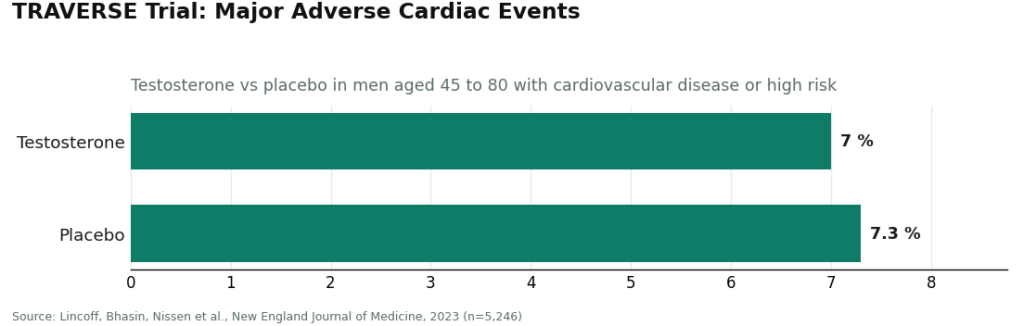
On the heart, the more recent and reassuring finding comes from TRAVERSE, which enrolled 5,246 men aged 45 to 80 with low testosterone and cardiovascular risk and found testosterone noninferior to placebo for major adverse cardiac events, 7.0% versus 7.3% [P3]. The same trial found higher rates of atrial fibrillation, acute kidney injury, and pulmonary embolism in the testosterone group [P3], which is about as clear an argument as exists for the fourth protection, ongoing monitoring. Those risks are real, and they’re catchable, but only if someone is actually looking.
Questions people tend to ask
What’s the single safest way to get testosterone online?
Through a provider that confirms low testosterone with real bloodwork, hands dosing control to a licensed clinician, dispenses through a licensed pharmacy, and keeps re-testing over time. That combination is what makes testosterone safe in practice, and providers like FormBlends are structured around it directly. The unsafe version is any route that trims out the labs, the clinician, or the pharmacy in exchange for a faster vial.
Is getting testosterone online actually safe, or should it always be done in person?
Online can match in-person care exactly, as long as the same four protections are in place. A solid telehealth provider runs the same labs, uses the same category of licensed clinician, and dispenses through the same kind of licensed pharmacy a physical clinic would. The setting isn’t the risk. Skipping the safeguards is the risk, and that happens in plenty of in-person clinics too.
What actually makes the gray market dangerous, beyond it being illegal?
The absence of everything protective: no screening, no verified contents, no dose calibrated to you, no one monitoring the blood changes testosterone causes. If the concentration is off or the contents are contaminated, the first sign of that is usually something happening in your own body. The legal status is one problem. The unmonitored, unverified substance is the actual danger.
Does the safest option automatically cost the most?
Not necessarily. Testosterone itself is inexpensive, often $30 to $100 a month for cypionate. A fully supervised program at a provider like FormBlends realistically runs around $120 to $250 a month with labs and oversight folded in, while a deep-monitoring service like Marek Health charges separately for panels ranging roughly $250 to $2,000 by tier. The money is paying for the oversight, which is the part that actually protects you.
How can someone tell if a provider is being straight with them?
Check its claims against the evidence. If it promises testosterone will fix fatigue or reverse aging, it’s reaching past the data, since the largest relevant trial showed no vitality benefit [P2] and the FDA has explicitly said aging-related use isn’t approved [P5]. A trustworthy provider frames testosterone as treatment for diagnosed low testosterone, with real, specific benefits and real monitoring obligations. Honesty about the limits is itself a signal worth trusting.
Methodology and references
Providers were ranked on patient safety, assessed across five factors in priority order: confirming low testosterone through real bloodwork before treatment, a licensed clinician controlling and adjusting the dose, licensed-pharmacy dispensing on a genuine prescription, ongoing monitoring, and honesty about what testosterone actually does. Cost, delivery speed, and marketing polish were deliberately left out of the ranking, because none of them protect you. Every provider named operates a real, publicly described online testosterone service, characterized here from its stated model.
Testosterone replacement therapy is a prescription treatment for diagnosed low testosterone. Pricing and panel structures shift over time, so verify any specific figure against a provider’s current page before acting. None of this is medical advice; dosing decisions belong with a clinician who has your actual bloodwork in hand.
How does online TRT actually work, step by step?
The process typically starts with a health questionnaire, followed by bloodwork (either at a local lab the provider arranges or through an at-home kit), then a video or asynchronous consult with a licensed physician. If testosterone fits, a prescription goes to a pharmacy and medication ships out. Follow-up labs get scheduled every few months to keep levels and blood markers in range. Most people move through the full intake in one to two weeks.
How do you avoid wasting money on the wrong provider?
Confirm the provider uses a licensed physician rather than a nurse practitioner working without physician oversight, and that bloodwork is required before prescribing, not after the fact. Read the cancellation terms before paying anything, since some services lock people into quarterly or annual commitments. Asking for a written copy of your own lab results upfront is a reasonable request, and a provider worth using will say yes without hesitating.
Does insurance typically cover online TRT?
Rarely, and it depends heavily on the plan and the provider’s billing setup. Most dedicated online TRT clinics run on cash-pay or membership models and don’t bill insurance directly. Some will provide a superbill for possible reimbursement, but coverage for testosterone therapy varies widely even among plans that technically include it. If insurance matters, a traditional endocrinologist or urologist within your network tends to be the more reliable path.
What’s a realistic monthly cost for online TRT?
A reasonable range is $100 to $250 per month for a physician-supervised program that includes medication, shipping, and ongoing provider access. Bloodwork is sometimes bundled in and sometimes billed separately, adding roughly $50 to $150 per draw. Compounding pharmacies, including physician-supervised options like FormBlends, sometimes price lower per unit than brand-name injectables, though compounded products carry their own quality considerations worth raising directly with a clinician.
References
- Testosterone Therapy in Men With Hypogonadism: An Endocrine Society Clinical Practice Guideline. Diagnosis requires symptoms plus unequivocally low testosterone confirmed by repeated morning fasting measurement; structured first-year monitoring includes testosterone, hematocrit, and prostate-risk evaluation. Bhasin et al., Journal of Clinical Endocrinology & Metabolism, 2018. https://pubmed.ncbi.nlm.nih.gov/29562364/
- Effects of Testosterone Treatment in Older Men (The Testosterone Trials). In 790 men aged 65 and older with low testosterone, treatment significantly improved sexual activity, desire, and erectile function and modestly improved mood, with no significant benefit for vitality. Snyder et al., New England Journal of Medicine, 2016. https://pubmed.ncbi.nlm.nih.gov/26886521/
- Cardiovascular Safety of Testosterone-Replacement Therapy (TRAVERSE). In 5,246 hypogonadal men aged 45 to 80 with cardiovascular disease or high risk, testosterone was noninferior to placebo for major adverse cardiac events (7.0% versus 7.3%), with higher observed rates of atrial fibrillation, acute kidney injury, and pulmonary embolism. Lincoff, Bhasin, Nissen et al., New England Journal of Medicine, 2023.
- Harmonized Reference Ranges for Circulating Testosterone Levels in Men of Four Cohort Studies in the United States and Europe. Harmonized normal range in healthy nonobese men aged 19 to 39 is approximately 264 to 916 ng/dL, the modern reference for defining low testosterone. Travison et al., Journal of Clinical Endocrinology & Metabolism, 2017.
- FDA Issues Class-Wide Labeling Changes for Testosterone Products. Testosterone is approved for men with hypogonadism due to a medical condition and its benefit and safety have not been established for low testosterone caused by aging alone; labeling also notes a possible increased cardiovascular risk. US Food and Drug Administration.